
Inside the stack · 03
Who builds Starship’s road to the Moon?
Starship’s first orbital cargo flight flew September 28. Follow the path to Moon cargo through HDR, Lerch Bates, Thompson, Axiom Space, Lockheed Martin, Toyota and JAXA.
Read the storyThis page did not load.

Start with a flight, a company, or the map. The record is the same in every room.
Upcoming flights. Open one for who flies it, what is on board, and the public money.
CompaniesCompanies on the next flights. Open a name for the jobs and the hardware.
NASA Moon BaseCargo I, II, III at the south pole. Crew in parallel on Artemis. A walk, not a list.
Open a flight for who flies it, what is on board, and the public money.
Open a company for the jobs, the hardware, and the flights they sit on.
Inside the stack · 03
Starship’s first orbital cargo flight flew September 28. Follow the path to Moon cargo through HDR, Lerch Bates, Thompson, Axiom Space, Lockheed Martin, Toyota and JAXA.
Read the story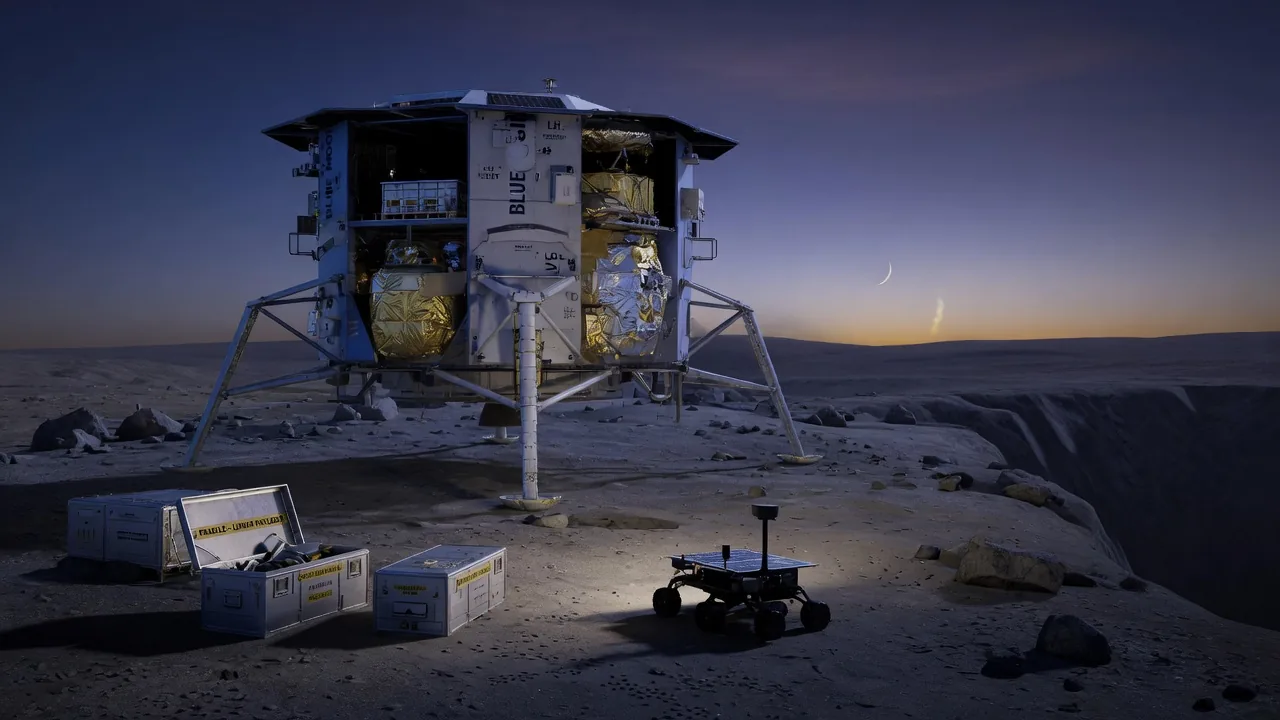
This is NASA's cargo-first Moon Base: landers put hardware on the land, then crew arrives. I, II, and III are NASA names, not fly order. Griffin-1 (II) is first on the clock.
 Landing map
Every public flight on the site it headed for. A globe of records, not a game map.
Open the mapLetters, flight files, and packs. Same named facts as the site. The price is for the PDF, not a ride.
Lunar site selection · modern era
Each flight sits on the site it headed for: landed, tipped, hard landing, or planned. Crew and orbit flights stay off the plate. One photograph of the near side, and a plotted chart of the south pole. Click a flight to open its Moon Imports record.
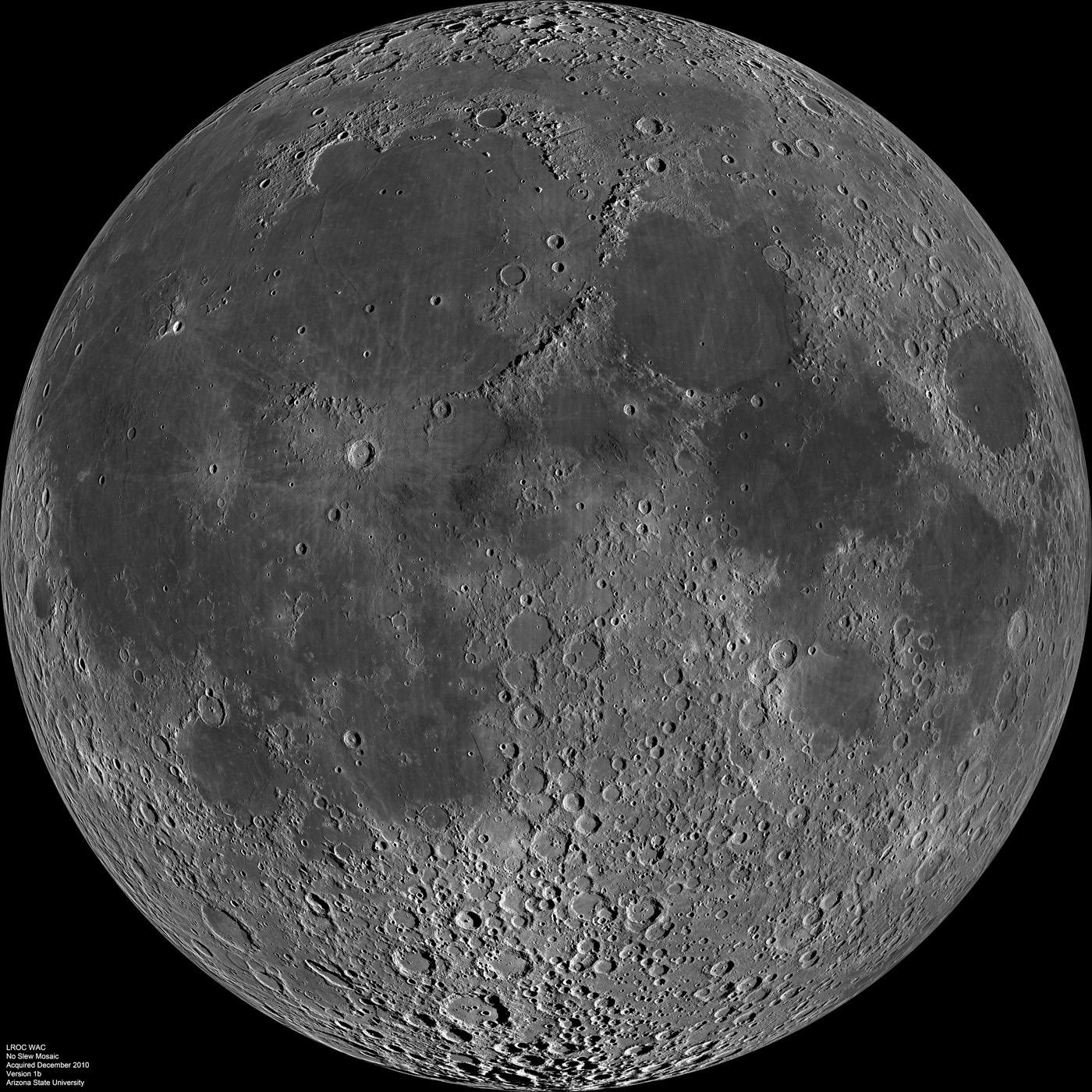
Photograph: NASA / GSFC / Arizona State University, LROC WAC nearside mosaic, public domain. The near-side plate is that photograph, clipped to the disk, under an orthographic graticule. The south pole plate is drawn, not photographed. Sites are the planned or intended target. Hard landings and flights that never arrived stay at the site they aimed for.
Program hub
A lasting presence at the south pole. NASA’s I, II, and III are names, not the order they fly. Cargo first. Crew in parallel.
| Mission | Who | Program | Rocket | When | Status | Cargo | Public $ |
|---|
Need a work PDF?
Pay on this page
Card stays with Stripe. You do not leave Moon Imports.
Change plan
One plan. Pick what you want next, then confirm the amount.
Inside the stack / 07
A Moon Base needs radios on the dirt and radios above it. On 30 September 2026 NASA Glenn awarded Modulate Space about $38 million for a 5G Network-in-a-Box with Wi-Fi 6 on the lunar surface. Lab work runs now. A surface flight demo is due by late 2028 on a lander that is still unnamed. LunaNet standards, commercial relays, and CAPSTONE already treat orbit around the Moon as a workplace.
What NASA awarded ↓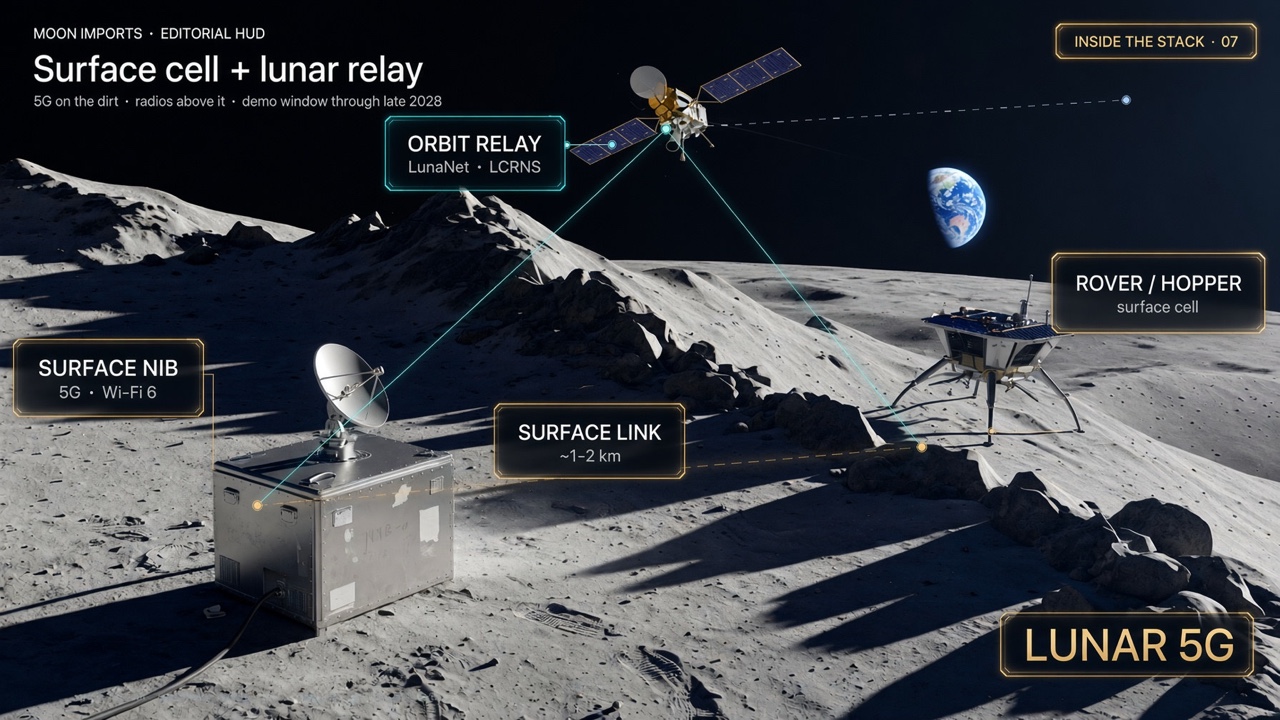
Today / 30 September 2026
NASA Headquarters contract release C26-014 named Modulate Space Corporation for the 5G System and Lunar Surface Communications Evaluation and Radio Propagation Measurements effort at NASA Glenn Research Center in Cleveland. The award is firm-fixed-price, about $38 million. Public award records put the contract number at 80GRC026C0017 and the place of performance in Boerne, Texas.
NASA frames the work as two primary areas that together build a scalable, standards-based capability for future Moon Base surface operations. The Network-in-a-Box lab demonstration runs from 1 October 2026 through 31 January 2028. The integrated surface network and flight demonstration run from 30 November 2026 through 31 December 2028. Through the demonstrations, Glenn acquires hardware, firmware, and software insight into architecture and performance, with room to evolve the surface network later. The release does not name a CLPS lander, a task order, or a flight day beyond the two performance windows.
The statement of work behind the sole-source path is more specific about the box. The Network-in-a-Box is a 5G New Radio system in band N78, with SideLink Mode 1 mesh under Network-in-a-Box control, Wi-Fi 6 access, and wideband antennas. The lunar surface flight demonstration connects a lander-mounted Network-in-a-Box to rover or hopper user equipment over a 1 to 2 kilometer range, characterizes lunar radio propagation, and calibrates models for later mission planning. Mass and seat dollars beyond the package award stay empty on our card.NASA: 5G for the Moon ↗ Award record 80GRC026C0017 ↗
About $38M FFP at Glenn. Lander unnamed. 1 to 2 km to rover or hopper UE.
Open the surface award ↓Interoperability standards, commercial relay seat, Gateway-class halo orbit flown.
Walk the orbital stack ↓Walk the surface award first, then the orbital hops that keep bits moving when Earth is blocked.
01 / Surface award
Modulate Space is the named contractor for NASA Glenn's lunar 5G path. The public company lede and the sole-source notice also record an also-known-as of Modul8 and a former Nokia Bell Labs Space Communication Solutions line. On this catalogue the company hop is Modulate Space, not a second firm. The job is an enable and ground-tech path with a flight demonstration window, not a CLPS lander task order.
What NASA is buying is a standards-based surface cell that can grow. Lab first: prove the Network-in-a-Box, the user equipment, Wi-Fi 6, and the hybrid architecture on Earth through January 2028. Then fly: put the box on a lander, put user equipment on a rover or hopper, close the 1 to 2 kilometer link on the Moon, and measure how the radio actually behaves in lunar dust and geometry. That measurement is the point. Future Moon Base surface ops need models calibrated on the real surface, not only in a chamber.
The honest gap stays on the card. Flight day is a window through the end of 2028, not a named NET. The host lander is empty. Package dollars are the award above, not a unit cost for the box. Keep this hop separate from Nokia's flown 4G system on Intuitive Machines' second lander, even where talent or prior lab lines overlap in the public notice language. NASA: 5G for the Moon ↗ Award record 80GRC026C0017 ↗
lunar 5G job ↗ unassigned 5G cargo ↗ Modulate Space on Moon Imports ↗
02 / Surface heritage
Before 5G, the Moon already had a cellular Network-in-a-Box. Nokia Bell Labs built the Lunar Surface Communications System (LSCS), a space-hardened 4G/LTE network, for Intuitive Machines' IM-2 mission in March 2025. Public reporting puts the NASA STMD Tipping Point path in the $14.1 million class. The payload's job was lander-to-surface links for users such as Lunar Outpost's MAPP rover and hoppers.
IM-2 tipped after landing. The surface window was short. Nokia and Intuitive Machines still reported that the cellular network reached the Moon and met some key mission objectives. MAPP's surface deploy was blocked by the tip. The catalogue keeps that honesty: first cellular network on the lunar surface, limited power and time, not a finished Moon Base campus network.
That flown 4G hop is why the Modulate award reads as a next step rather than a first try. Same product idea, Network-in-a-Box on a lander, user equipment on surface vehicles, different generation and a longer funded demo arc. Do not merge the two companies or the two flights. IM-2 owns Nokia LSCS. Modulate's lander is still unnamed. Nokia × Intuitive Machines release ↗
Nokia LSCS job ↗ IM-2 LSCS cargo ↗ Nokia on Moon Imports ↗ IM-2 flight ↗
03 / Orbit standards
Surface cells still need a path home when Earth is blocked. NASA, ESA, and JAXA frame LunaNet as shared standards so government, commercial, and international systems can operate as one cooperative network at the Moon. Networking, navigation, detection and information, and radio or optical science sit under that umbrella. LunaNet is not a single satellite. It is the rulebook that lets many providers plug in.
NASA's first LunaNet-class implementation path is the Lunar Communications Relay and Navigation Systems project, or LCRNS, under the Space Communications and Navigation program. Relays in orbit around the Moon cover places where Earth is not in view, especially the south pole and far side. Once operational, those relays are meant to sit inside NASA's Near Space Network, the government and commercial assets that support missions within about 1.25 million miles of Earth.
In 2024 NASA competitively selected Intuitive Machines under the Near Space Network Services contract as the first commercial LCRNS service provider. The catalogue job is the multi-mission lunar relay path across later IM flights. Service dollars and individual seat prices stay empty. Interoperability runs through the LunaNet Interoperability Specification, so later providers can join without inventing a private dialect. That is the orbital half of the same workplace Modulate is building toward on the surface: bits that move when a crater rim or the lunar far side cuts the Earth line. NASA: LunaNet ↗ NASA Goddard: LCRNS ↗
04 / Commercial relay seat
Before LCRNS relays are operational, a commercial relay seat is already sold on Firefly's dual-spacecraft stack. ESA and SSTL fly Lunar Pathfinder on Blue Ghost Mission 2 / Elytra, targeted no earlier than 2027. Elytra carries Blue Ghost and Pathfinder into orbit around the Moon, deploys them, then Blue Ghost continues to a far-side landing while Elytra and Pathfinder cover relay for polar and far-side ops without a direct Earth line of sight. Pathfinder talks to lunar surface and orbit assets on dual S-band and relays to Earth on X-band.
Public package figures on the record put the ESA anchor path in the $23.5 million class, about €20 million over a multi-year service reported from the 2021 anchor-customer path. A UKSA-backed GNSS receiver on Pathfinder, built with EECL, also tries to lock weak GPS and Galileo signals at the Moon. Navigation truth and relay service ride the same prior Elytra residual that Mission 3 later sells to compute. For this communications cut, Pathfinder is the proof that orbit around the Moon is already a product floor, not only a government instrument bay. Firefly: Blue Ghost Mission 2 ↗ ESA BSGN: Lunar Pathfinder ↗
Lunar Pathfinder job ↗ Pathfinder GNSS ↗ Blue Ghost Mission 2 ↗ SSTL on Moon Imports ↗
05 / Gateway-class orbit
Advanced Space operates CAPSTONE for NASA: a CubeSat that entered and characterized a near rectilinear halo orbit (NRHO), the same orbit family planned for Gateway. Launch was 28 June 2022 on Rocket Lab Electron with Lunar Photon transfer. The pathfinder covers timing, propulsion, and CAPS peer-to-peer navigation in cislunar space. Named builders on the public stack include Terran Orbital for the 12U bus, Stellar Exploration for propulsion, Space Dynamics Lab for the Iris radio, Tethers Unlimited for the cross-link radio, and Orion Space Solutions for the chip-scale atomic clock.
It is not a surface cell, and it is not a data center. It is the public demonstration that a small commercial stack can live in a useful orbit around the Moon and return navigation and communications truth for later vehicles. NASA later named Advanced Space as prime for CAPSTONE 02, announced path NET 2027. Utah State University Space Dynamics Laboratory supplies the communications system on that follow-on, including direct-to-Earth radios and the crosslink between the two spacecraft. The NRHO enable rail stays open even while Gateway station work is paused. NASA: CAPSTONE ↗
CAPSTONE pathfinder ↗ CAPSTONE 02 SDL radios ↗ CAPSTONE flight ↗ Advanced Space on Moon Imports ↗
06 / Other orbital paths
Three more hops sit on the orbital board without becoming the Modulate lander story.
ispace Mission 4 is expected to deploy a communications relay into lunar orbit to support polar payload ops and the Lunar Connect data-relay service path, with ops tied to Mission 4 NET 2029. The company language is "expected to deploy." Bus OEM stays empty until named. Lunar Connect relay job ↗
Vast Lunar Programs, opened 23 September 2026, proposes a communications and positioning constellation for continuous south pole coverage, framed as a complement to NASA's planned LCRNS network and a way to reduce pressure on shared Deep Space Network assets. Flight day is not public. Mission slugs stay empty. That is a product-line vision on the record, not a manifested lunar launch. Vast south-pole comms job ↗
Gateway still names an ESA lunar communications contribution on HALO for high-rate links between the lunar surface and the station. NASA paused Gateway work in March 2026. Treat HALO communications as a named partner contribution on a paused station stack, not as a live NET for this article. HALO lunar communications ↗
Forward look
Read together, the public record is no longer only a lander modem and a Deep Space Network pass. On the surface, Nokia proved a cellular Network-in-a-Box can reach the Moon, and Modulate is funded to take a 5G and Wi-Fi 6 box through lab proof and a late-2028 surface flight demo over about 1 to 2 kilometers. Above the surface, LunaNet sets the interoperability rules, Intuitive Machines is the first commercial LCRNS relay provider under the Near Space Network, Lunar Pathfinder sells a relay seat on Elytra, and CAPSTONE already flew the halo orbit later vehicles need.
What this article does not claim: a named CLPS lander for Modulate, an operational Moon Base campus network, Modul8 as a separate company, or a flying Gateway. The hop that is live today is the ~$38 million Glenn award, the two performance windows, the unassigned surface cargo card, and the orbital enable rail already densified beside it.
For builders of radios, antennas, user equipment, and long-lived relay buses, the workplace is split across dirt and orbit on purpose. The surface cell moves bits between a lander and the vehicles around it. The orbital layer keeps those bits moving when Earth disappears behind a crater rim. Both have to work before a Moon Base can stay busy through the night and across the far side.
Open the News kit · company card for Modulate Space