Inside the stack · 03
Who builds Starship’s road to the Moon?
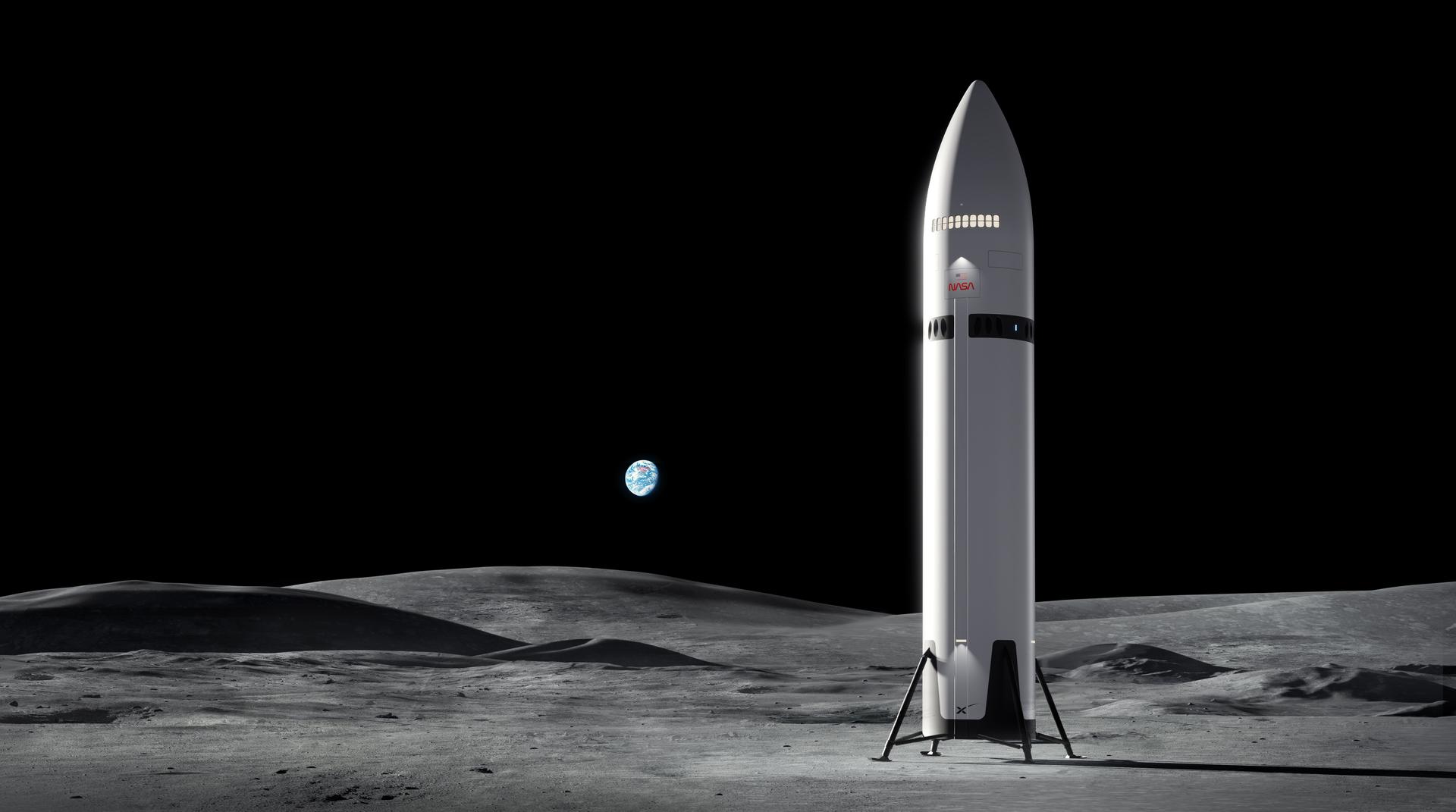
Starship’s first orbital cargo flight flew September 28. Follow the path to Moon cargo through HDR, Lerch Bates, Thompson, Axiom Space, Lockheed Martin, Toyota and JAXA.
Read the storyThis page did not load.
Start with a flight, a company, or the map. The record is the same in every room.
Upcoming flights. Open one for who flies it, what is on board, and the public money.
CompaniesCompanies on the next flights. Open a name for the jobs and the hardware.
NASA Moon BaseCargo I, II, III at the south pole. Crew in parallel on Artemis. A walk, not a list.
Open a flight for who flies it, what is on board, and the public money.
Open a company for the jobs, the hardware, and the flights they sit on.
Inside the stack · 03
Starship’s first orbital cargo flight flew September 28. Follow the path to Moon cargo through HDR, Lerch Bates, Thompson, Axiom Space, Lockheed Martin, Toyota and JAXA.
Read the story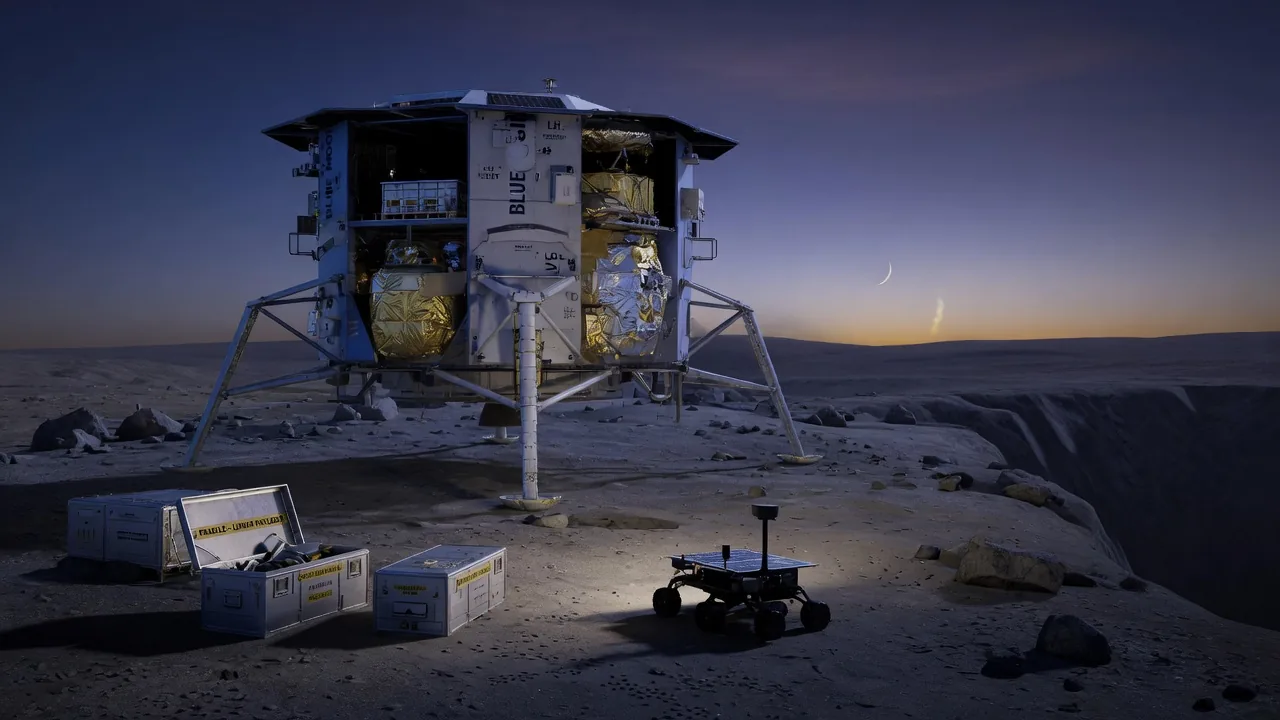
This is NASA's cargo-first Moon Base: landers put hardware on the land, then crew arrives. I, II, and III are NASA names, not fly order. Griffin-1 (II) is first on the clock.
 Landing map
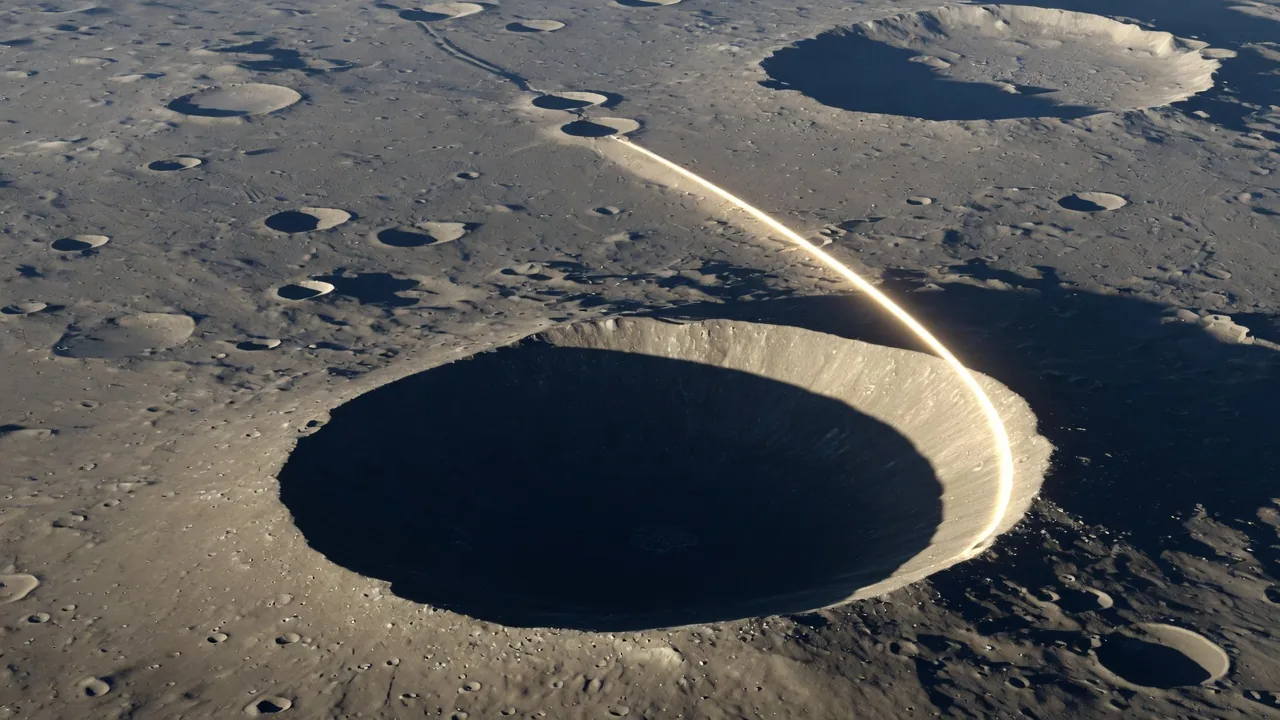
Every public flight on the site it headed for. A globe of records, not a game map.
Open the mapLetters, flight files, and packs. Same named facts as the site. The price is for the PDF, not a ride.
Lunar site selection · modern era
Each flight sits on the site it headed for: landed, tipped, hard landing, or planned. Crew and orbit flights stay off the plate. One photograph of the near side, and a plotted chart of the south pole. Click a flight to open its Moon Imports record.
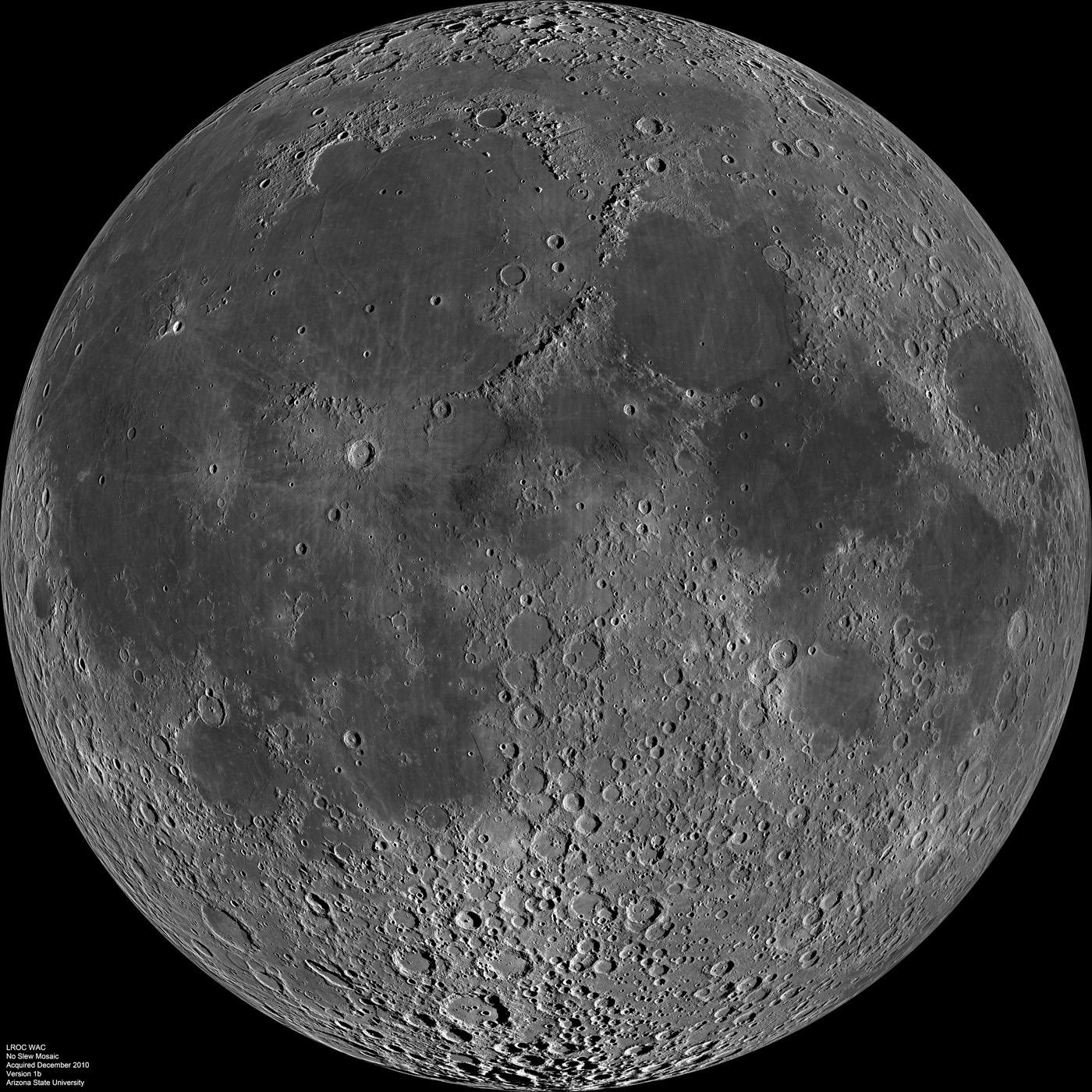
Photograph: NASA / GSFC / Arizona State University, LROC WAC nearside mosaic, public domain. The near-side plate is that photograph, clipped to the disk, under an orthographic graticule. The south pole plate is drawn, not photographed. Sites are the planned or intended target. Hard landings and flights that never arrived stay at the site they aimed for.
Program hub
A lasting presence at the south pole. NASA’s I, II, and III are names, not the order they fly. Cargo first. Crew in parallel.
| Mission | Who | Program | Rocket | When | Status | Cargo | Public $ |
|---|
Need a work PDF?
Pay on this page
Card stays with Stripe. You do not leave Moon Imports.
Change plan
One plan. Pick what you want next, then confirm the amount.
Inside the stack / 06
A lander day on the Moon is finite. The vehicle that carried it does not have to be. On 30 September 2026 Firefly signed Starcloud to fly SC-1L compute on Elytra during Blue Ghost Mission 3 residual orbit. Relays, pathfinders, and imaging already treat cislunar space as a workplace.
What Firefly announced today ↓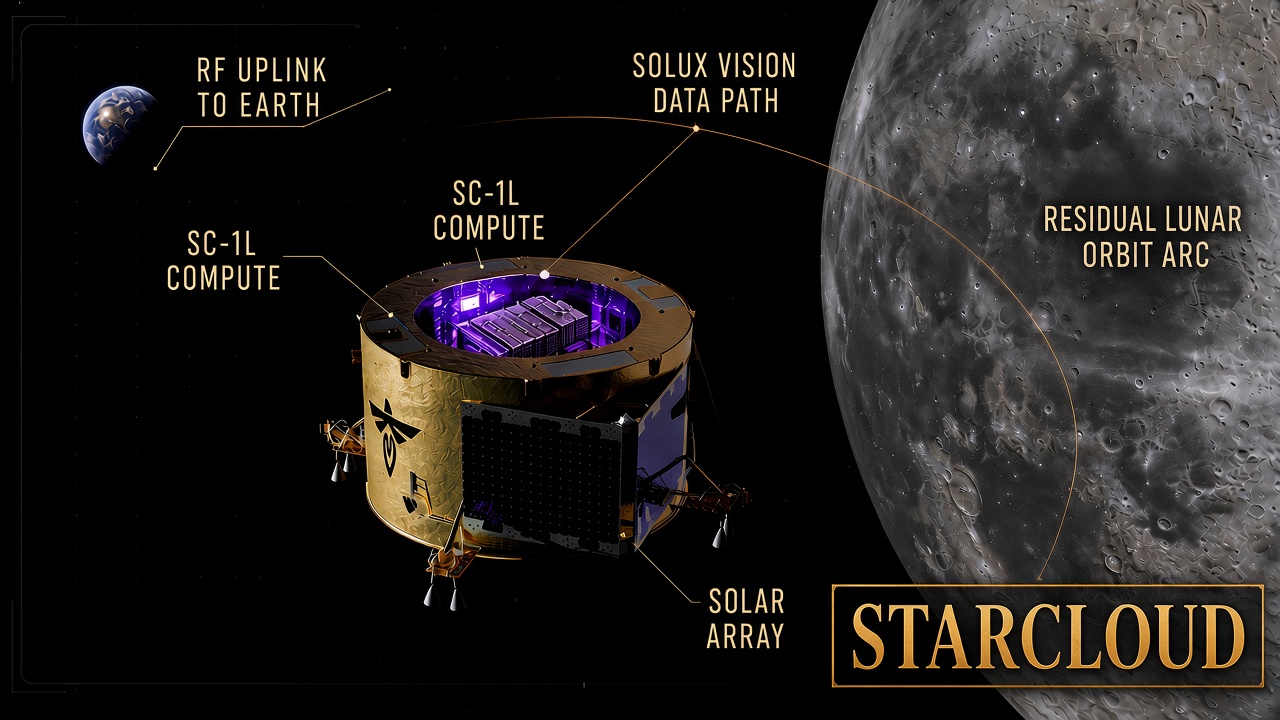
Today / 30 September 2026
Firefly Aerospace (Nasdaq: FLY) announced a commercial payload agreement with Starcloud from Cedar Park, Texas. Starcloud's SC-1L compute payload flies onboard Firefly's Elytra orbital vehicle on Blue Ghost Mission 3 to validate core capabilities for a future data center around the Moon that can support surface and orbital infrastructure. Elytra first transfers the Blue Ghost lander and runs as the communications relay for the Gruithuisen Domes landing, targeted no earlier than 2028. Then it stays in orbit around the Moon for up to five years. In that residual window SC-1L takes Solux vision data, runs high power AI on orbit, and sends processed results to Earth.
"We're proud to collaborate with innovative customers like Starcloud and collectively take another step toward establishing the infrastructure that will power a permanent human and robotic presence at the Moon," said Ray Allensworth, Vice President of Spacecraft at Firefly Aerospace. "By pairing Starcloud's AI computing payload with our Elytra vehicle and Solux vision system, we're demonstrating how data can be captured, processed, and delivered from lunar orbit, laying the groundwork for the computing infrastructure future lunar operations will depend on."
"Space is the future of data centers, and the Moon is the next frontier for that vision," said Ezra Feilden, Cofounder and CTO at Starcloud. "We successfully validated our ability to run and train AI models on enterprise grade GPUs in low Earth orbit, and now we're taking this proven technology to lunar orbit. Onboard Firefly's Elytra vehicle, we'll demonstrate high-power AI computing and further prove we can process massive volumes of data right where it's generated to support the growing infrastructure beyond Earth."
On Firefly's Gruithuisen Domes mission page, the customer line already reads NASA and Starcloud. The lander still delivers six NASA-sponsored instruments and a Honeybee Robotics rover to the Gamma Dome region for more than 14 days of surface ops. SC-1L is not one of those surface instruments. It rides the Elytra residual after lander transfer and relay duties. The flight page is Blue Ghost Mission 3 / Elytra, not a cargo-named slug.GlobeNewswire: Starcloud commercial customer, 30 September 2026 ↗ Firefly: Gruithuisen Domes mission page ↗
Named commercial seat. Solux in, AI on orbit, processed results to Earth. Seat $ unpublished.
Open the compute seat ↓Relay sold, halo orbit flown, imaging revisits planned, ground path named.
Walk the orbital stack ↓Walk the Mission 3 compute seat first, then the prior Elytra and cislunar hops that make residual orbit a workplace.
01 / Compute seat
Starcloud is the named commercial customer for SC-1L on Firefly's third lunar mission. Public release language is specific: the processor ingests data from Firefly's Solux vision system, performs high power AI computing on orbit, and transmits processed results to Earth. The demonstration extends Starcloud's earlier AI computing work in low Earth orbit into orbit around the Moon. Firefly and Starcloud frame it as validation for a future orbital lunar data center that can support surface and orbital infrastructure. Seat dollars and mass are not public.
That seat sits on a densified residual floor, not on the CLPS surface task order alone. CP-21 package dollars for Blue Ghost surface delivery are a different card. Starcloud is onboarded to the third lunar mission; Elytra is the host after lander transfer and relay. The hop that is live today is the commercial agreement dated 30 September 2026, the Elytra host on Mission 3, and the up-to-five-year residual window. A future orbital lunar data center is the validation target in the release language, not a facility already on the map. Firefly: Gruithuisen Domes ↗ GlobeNewswire: Starcloud commercial customer, 30 Sep 2026 ↗
Starcloud SC-1L job ↗ SC-1L cargo ↗ Starcloud on Moon Imports ↗ SC-1L hardware ↗
02 / Orbit host
Firefly Aerospace builds Blue Ghost landers and Elytra orbital vehicles on the same Cedar Park line. On the dual-spacecraft stack, Elytra Dark is the bottom stage: it carries Blue Ghost from Earth toward the Moon, deploys the lander into orbit around the Moon, then remains on orbit for long-haul relay. Public Firefly materials put each Elytra in orbit around the Moon for up to five years after the primary mission. Blue Ghost Mission 2 is the first Elytra lunar path (NET ~2027, far-side stack with Lunar Pathfinder). Mission 3 is the second Elytra to the Moon, targeted no earlier than 2028 for the Gruithuisen Domes.
Formerly called Sol3, Firefly's Solux vision system on Elytra supports autonomous navigation and orientation where GNSS and GPS are unavailable. Elytra also carries high resolution telescopes for Firefly's Ocula lunar imaging service: surface mapping, mineral detection, and reconnaissance from orbit. Firefly has also described onboard processing for Ocula with NVIDIA Jetson hardware through its SciTec subsidiary, so imaging data can be reduced in orbit around the Moon before downlink. That is the same residual floor Starcloud is buying into: capture on Solux, compute on SC-1L, imaging life on Ocula, bits home through the relay path. Firefly: Ocula ↗ Firefly: Blue Ghost Mission 2 ↗
On the Mission 3 stack itself, Firefly describes Blue Ghost stacked on Elytra Dark with a Honeybee rover on the lander top deck. Elytra handles transfer and long-haul relay; Blue Ghost lands at the Gruithuisen Domes near Sinus Viscositatis and runs the six NASA-sponsored surface instruments for more than 14 days. Starcloud's seat begins after that transfer and relay phase, in the multi-year residual window.
Elytra Dark on BG-M3 ↗ Blue Ghost Mission 3 ↗ Blue Ghost Mission 2 ↗ Firefly on Moon Imports ↗
03 / BG-M2 orbital seat
Before Mission 3's compute seat, Blue Ghost Mission 2 sold an orbital communications seat. ESA and SSTL fly Lunar Pathfinder as a commercial lunar relay on the BG-M2 / Elytra stack, targeted no earlier than 2027. Firefly's dual spacecraft stack carries Blue Ghost on Elytra; once in orbit around the Moon, Elytra deploys Blue Ghost and Pathfinder. Blue Ghost continues to a far-side landing while Elytra and Pathfinder cover relay for polar and far-side ops without direct line of sight to Earth. Pathfinder communicates with lunar surface and orbit assets on dual S-band, then relays to Earth on X-band.
Public package figures on the record put the ESA anchor path in the $23.5 million class (about €20 million over multi-year service, reported from the 2021 anchor-customer path). That is orbital infrastructure sold as a product, not only as a government instrument. A UKSA-backed GNSS receiver on Pathfinder, built with European Engineering and Consultancy (EECL), also tries to lock weak GPS and Galileo signals at the Moon. Navigation truth and relay service ride the same prior Elytra residual that Mission 3 now sells to compute. Firefly: Blue Ghost Mission 2 ↗
Lunar Pathfinder job ↗ Pathfinder GNSS demo ↗ SSTL on Moon Imports ↗ EECL on Moon Imports ↗ Blue Ghost Mission 2 ↗
04 / NRHO pathfinder
Advanced Space operates CAPSTONE for NASA: a CubeSat that entered and characterized a near rectilinear halo orbit, the same orbit family planned for Gateway. Launch was 28 June 2022 on Rocket Lab Electron with Lunar Photon transfer. The pathfinder covers timing, propulsion, and CAPS navigation in cislunar space. Named builders on the public stack include Terran Orbital (12U bus), Stellar Exploration (hydrazine propulsion), Space Dynamics Lab (Iris radio and navigation firmware), Tethers Unlimited (cross-link radio), and Orion Space Solutions (chip-scale atomic clock). It is not a Blue Ghost ride, and it is not a data center. It is the public demonstration that a small commercial stack can live in a useful orbit around the Moon and return navigation truth for later vehicles. NASA: CAPSTONE ↗
NASA later named Advanced Space as prime for CAPSTONE 02 (announced path NET 2027). That follow-on stays on the NRHO enable rail. It does not reassign Starcloud's Elytra seat.
CAPSTONE pathfinder job ↗ CAPSTONE flight ↗ Advanced Space on Moon Imports ↗ Terran Orbital on Moon Imports ↗
05 / Imaging constellation
Firefly's Ocula path uses Elytra vehicles left in orbit around the Moon after Blue Ghost missions as an imaging constellation. On Blue Ghost Mission 2, Lawrence Livermore National Laboratory telescopes enable that residual imaging life after the CLPS phases. Mission 3 and Mission 4 add further Elytra units on the same product line. Revisit times matter for mineral mapping and site reconnaissance. The same multi-year orbit window that hosts Ocula is the window Starcloud is using for compute, with Solux vision as the AI feed and SciTec / NVIDIA Jetson processing described for Ocula downlink reduction. Firefly: Ocula ↗
Ocula constellation path ↗ Ocula LLNL telescopes on BG-M2 ↗ LLNL on Moon Imports ↗
06 / Enable rail
Intuitive Machines has a public Near Space Network lunar relay path for multi-mission communications across later IM flights. That path is an enable layer for lunar traffic, separate from Firefly's Elytra residual seats, but part of the same workplace: keep the bits moving when landers and orbiters need a path home.
Goonhilly Earth Station appears on the record for deep space ground stations supporting lunar tracking, telemetry, and data from Cornwall. Public notes placed Goonhilly antennas in IM's lunar TT&C network on earlier missions. On 14 May 2026 Intuitive Machines signed to acquire Goonhilly Earth Station Ltd and Goonhilly USA; the deal closed 3 August 2026. Orbit only becomes useful when the bits reach Earth. Those hops sit on the enable rail: not Starcloud's seat, but part of how orbit services around the Moon stay reachable.
IM NSN relays ↗ Goonhilly on Moon Imports ↗ Intuitive Machines on Moon Imports ↗
Forward look
Read together, the public record is no longer only landers and surface hours. Elytra sells transfer, relay, imaging, and now a named compute customer on residual orbit. Pathfinder sold a relay on the prior Elytra. CAPSTONE proved a halo orbit with a named commercial stack. Starcloud is trying to prove that AI processing can happen next to the Moon, where the data is generated, instead of waiting for every raw bit to cross the Earth link.
Seat dollars stay empty on our card until a primary source publishes them. The hop that is live today is the commercial agreement, the Elytra host, and the Mission 3 residual window. A future data center around the Moon is the validation target in the release language, not a built facility on the map.
MoonFall remains a separate south-pole hop-drone flight: Firefly Elytra carries four JPL drones from Earth orbit and deploys them mid-descent for surface hops. That is a lander-adjacent surface beat. It does not belong in this orbital cut.
For builders of radios, telescopes, GPUs, and long-lived buses, the workplace is already moving above the surface. After the lander leaves, the orbit still has years of work left.
Open the News kit · flight card for Blue Ghost Mission 3