Inside the stack · 13
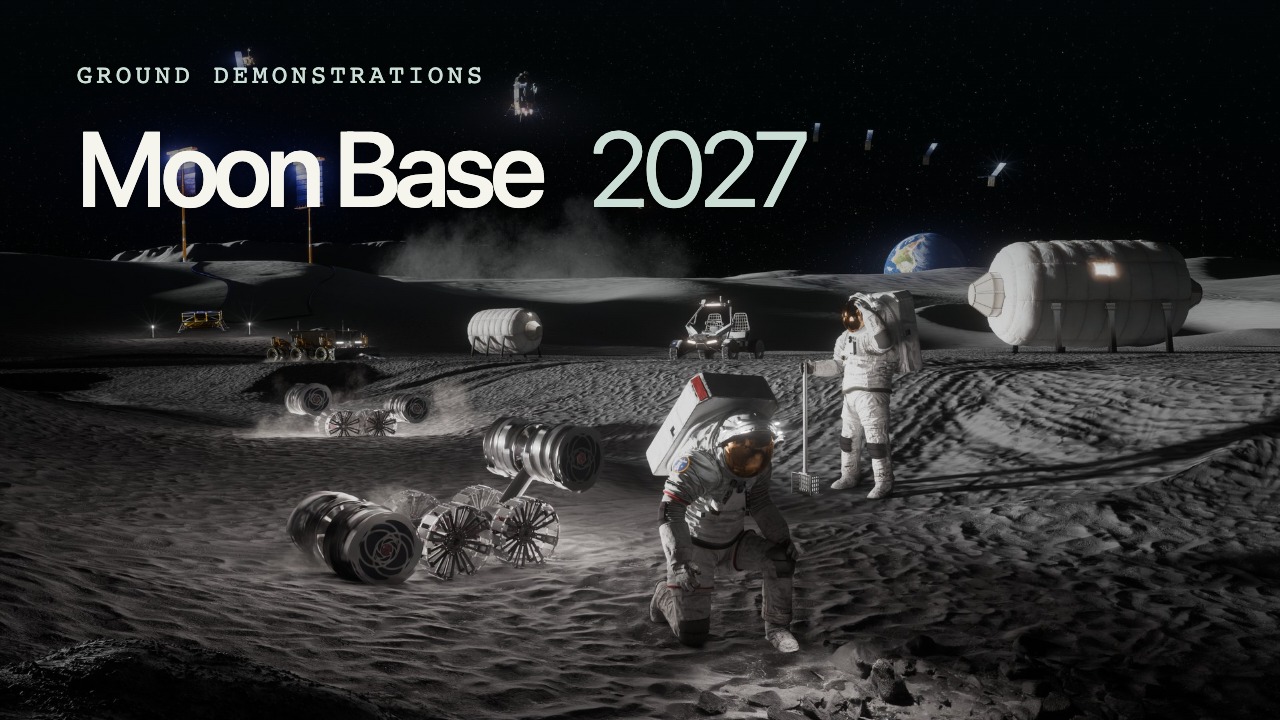
The rovers preparing for a Moon Base
Follow FLIP, MAPP and VIPER from their builders to their mission objectives, and see how robotic exploration can prepare the ground for Artemis astronauts.
Read the storyThis page did not load.
Start with a flight, a company, or the map. The record is the same in every room.
Upcoming flights. Open one for who flies it, what is on board, and the public money.
CompaniesCompanies on the next flights. Open a name for the jobs and the hardware.
NASA Moon BaseGriffin-1 targets November 2026, then Endurance and Trinity in early 2027. Artemis III docks in Earth orbit, targeted for Q3 2027.
Open a flight for who flies it, what is on board, and the public money.
Open a company for the jobs, the hardware, and the flights they sit on.
Inside the stack · 13
Follow FLIP, MAPP and VIPER from their builders to their mission objectives, and see how robotic exploration can prepare the ground for Artemis astronauts.
Read the storyInside the stack · 12
October’s power and surface mating calls set the next development steps toward NASA’s Moon Base. Follow the 2027 ground test target, relevant builders and mission records.
Read the story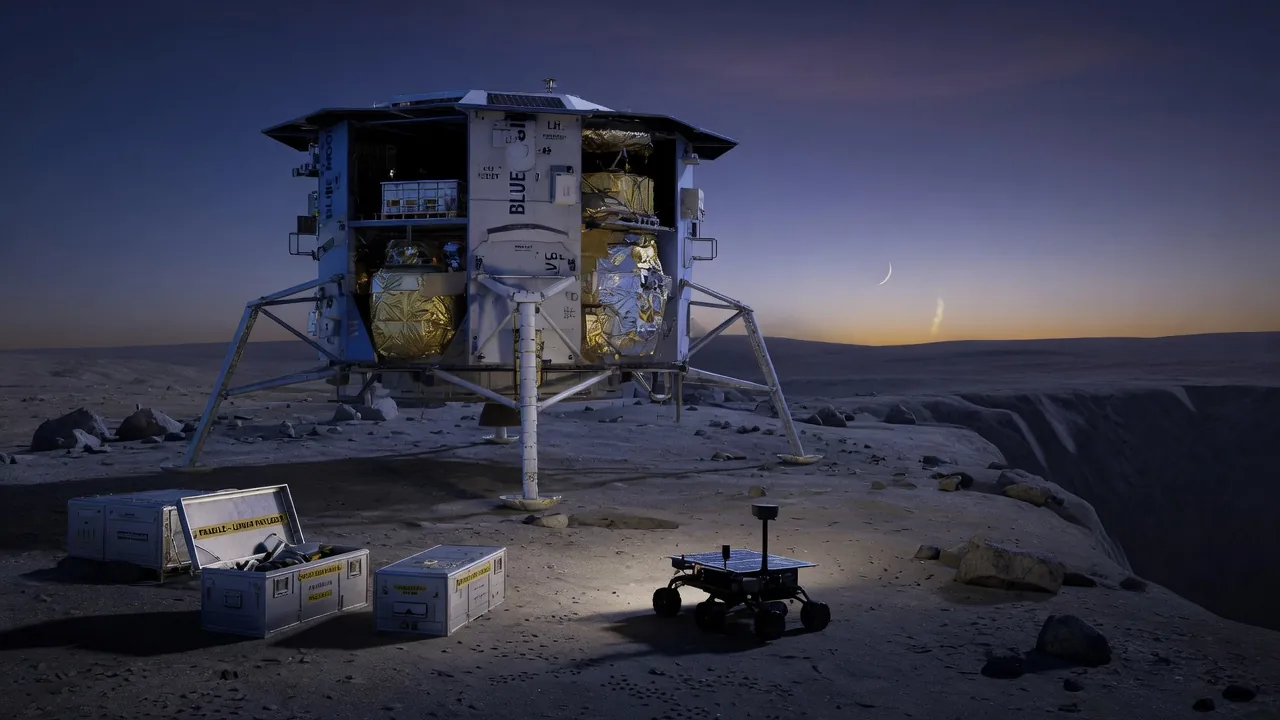
NASA's first three Moon Base landings: Moon Base II, Griffin-1, launches first, NET November 2026; Moon Base I, Endurance, and Moon Base III, Trinity, follow in early 2027.
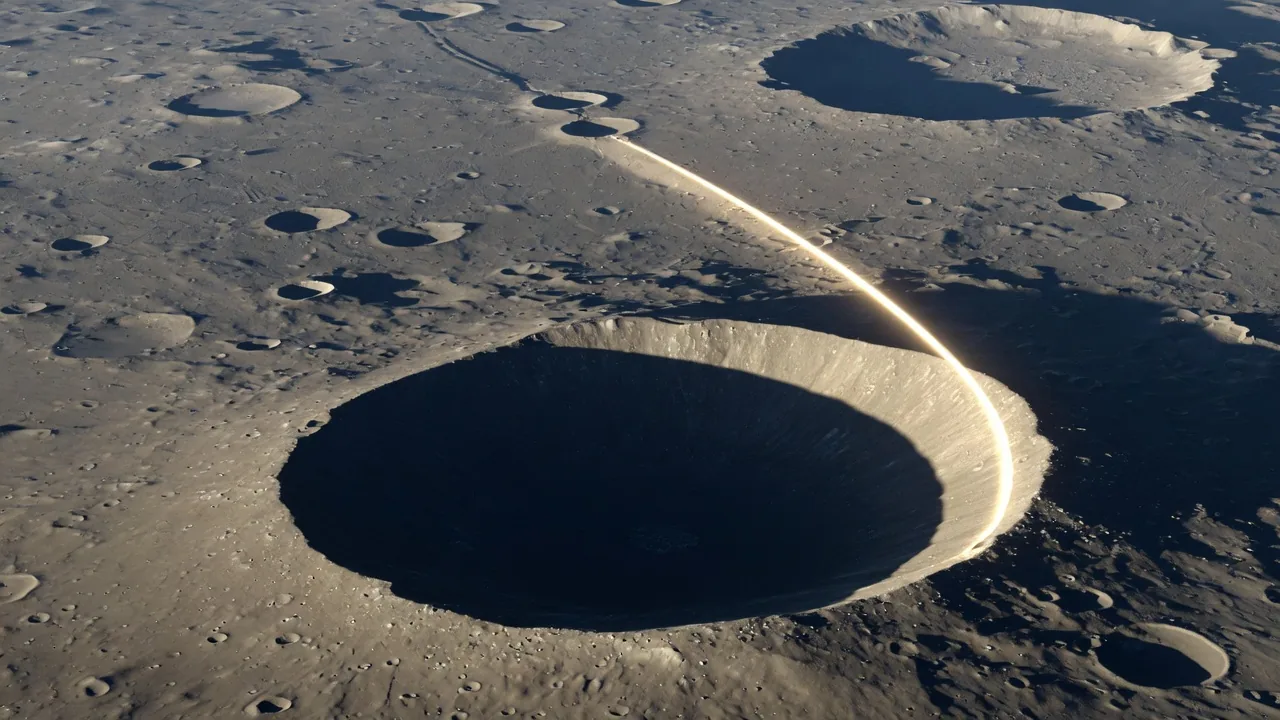 Landing map
Every public flight on the site it headed for. Each dot is a sourced record.
Open the mapLetters, flight files, and packs. Same named facts as the site. The price covers the PDF.
Lunar site selection · modern era
Each flight sits on the site it headed for: landed, tipped, hard landing, or planned. Crew and orbit flights stay off the plate. One photograph of the near side, and a plotted chart of the south pole. Click a flight to open its Moon Imports record.
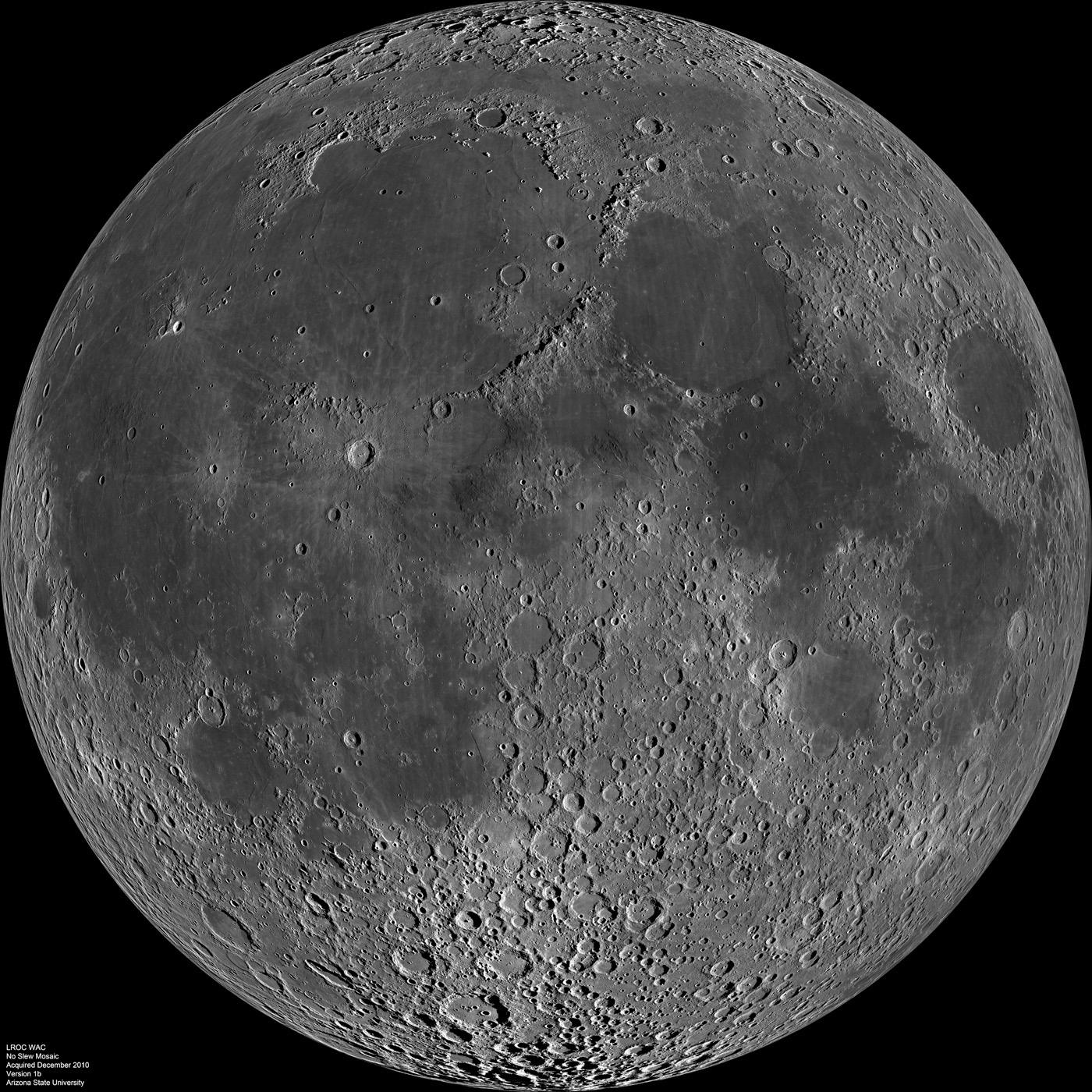
Photograph: NASA / GSFC / Arizona State University, LROC WAC nearside mosaic, public domain. The near-side plate is that photograph, clipped to the disk, under an orthographic graticule. The south pole plate is a drawing. Sites are the planned or intended target. Hard landings and flights that never arrived stay at the site they aimed for.
Program hub
A lasting presence near the south pole. NASA’s first three Moon Base landings fly in this order: Griffin-1 NET November 2026, then Endurance and Trinity in early 2027. Artemis III docks in low Earth orbit, targeted for Q3 2027.
| Mission | Who | Program | Rocket | When | Status | Cargo | Public $ |
|---|
Need a work PDF?
Pay on this page
Card stays with Stripe. You do not leave Moon Imports.
Change plan
One plan. Pick what you want next, then confirm the amount.
Inside the stack / 13
Astrolab’s FLIP will take rover hardware and science instruments to the Moon aboard Griffin-1. MAPP will carry a mobile investigation across a lunar swirl. VIPER will search polar terrain for water. Meet the builders behind these missions and the work that could help Artemis astronauts explore farther and stay longer.
From the workshop to the surface ↓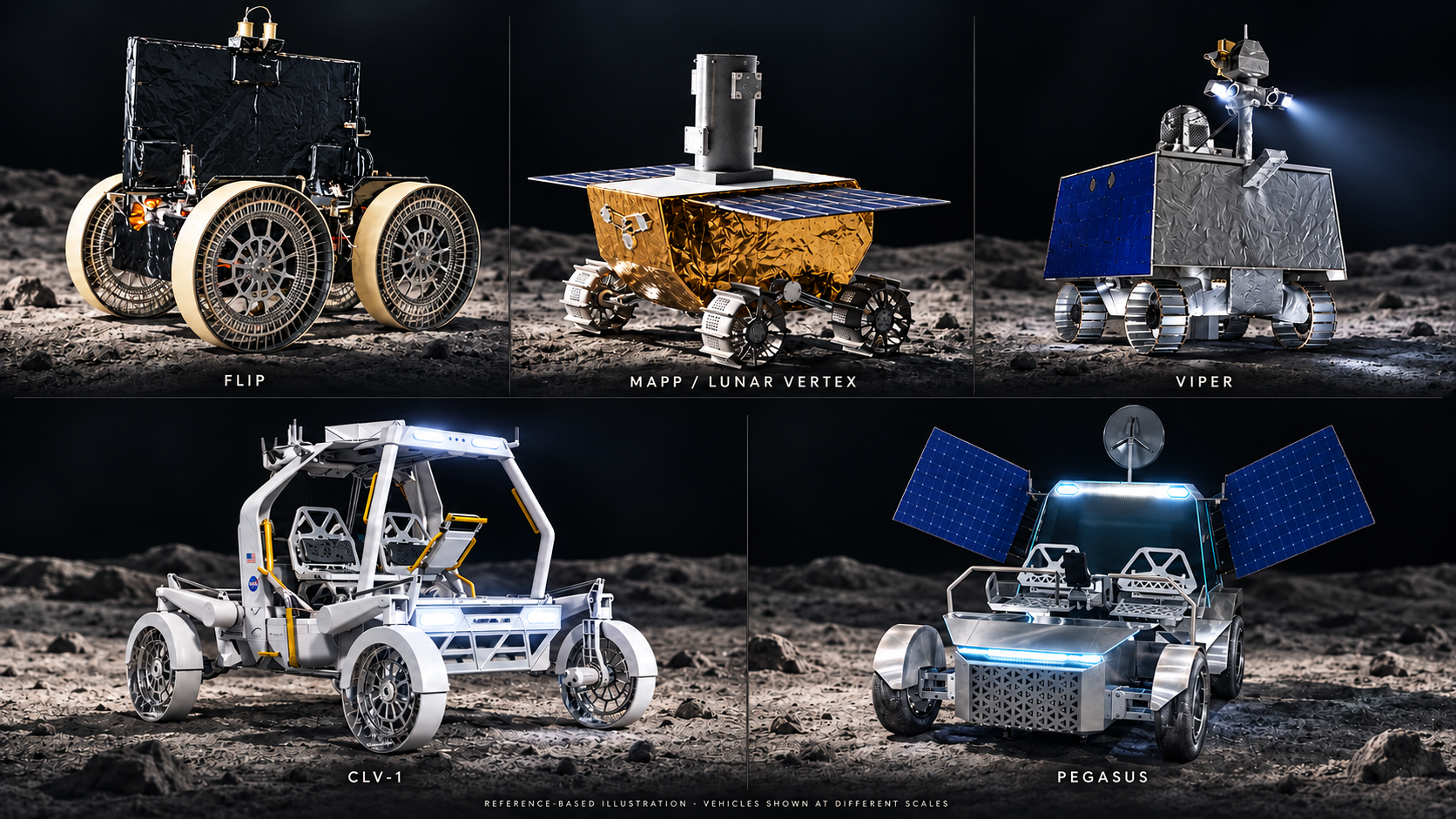
Programme update · October 2026
On Griffin-1, Astrolab’s FLIP will test rover equipment and carry mapping and dust experiments. MAPP will measure magnetic fields and examine soil at Reiner Gamma. VIPER will investigate the depth, concentration and form of polar water. Together, these missions address how to drive, measure and prospect on the lunar surface.Astrolab’s FLIP mission and payloads ↗
NASA’s 20 October rover update connects that work to a larger surface mobility programme. Robotic missions will investigate resources and test equipment; crewed vehicles will help astronauts reach scientific sites with their tools and return with samples. For a Moon Base, those capabilities connect exploration to daily work: moving instruments between sites, collecting samples and transporting supplies.NASA’s October rover update ↗
01 / Astrolab and Venturi Space
The FLEX Lunar Innovation Platform, or FLIP, is Astrolab’s first lunar rover. Its ride is Griffin-1, with launch planned for late 2026. The mission gives Astrolab a mobile platform for scientific payloads and engineering measurements before its larger vehicles enter service.Astrolab: FLIP aboard Griffin-1 ↗
Astrolab identifies Venturi as the developer of FLIP’s deformable wheels and battery enclosure. Our Griffin-1 supplier article follows the wider delivery stack. The link to future vehicles is in the hardware: FLIP provides a lunar test platform before Astrolab sends its astronaut rover.Astrolab: FLIP’s development role ↗
NASA identifies tires, batteries, radios and cameras as subsystems that FLIP and CLV-1 will share in similar forms. Operating them on the Moon lets engineers assess mobility, power, communications and imaging together. Those functions determine whether a rover can reach a work site, keep its instruments running and return data to its operators.NASA: FLIP as a CLV-1 subsystem testbed ↗
Astrolab’s Crewed Lunar Vehicle 1, or CLV-1, draws on its FLEX architecture. The company says CLV-1 uses tires, batteries and battery management technology developed by Venturi Space for its earlier rover work. FLIP’s flight therefore offers operating experience with the kinds of wheel and power systems intended for CLV-1.Astrolab: the CLV-1 team and hardware ↗
02 / Instruments and onboard processing
FLIP’s announced NASA payloads include Marshall Space Flight Center’s Lunar LiDAR Demonstration, which uses light detection and ranging for detailed three-dimensional mapping. Johnson Space Center’s Lunar Dust level sensor and Effects on Surfaces, or LDES, will measure thermal performance as dust accumulates on surfaces. The maps are intended to support navigation and obstacle avoidance. The dust measurements address a separate problem: dust-covered surfaces can lose their ability to shed heat, reducing the cooling available to onboard equipment.Astrolab: NASA mapping and dust investigations ↗
HPE plans to add Spaceborne Computer-4, a computing module intended to run high-performance computing benchmarks and AI experiments aboard FLIP. Benchmarks measure computing performance through defined workloads; the AI experiments will test image analysis and LiDAR processing on the lunar surface.HPE’s October 20 mission announcement ↗
For a rover, onboard computing means analysing measurements where they are collected. HPE’s planned LiDAR tests will process laser measurements for mapping, navigation and terrain analysis; vision inference applies trained AI models to images. Doing that work on the Moon could let future missions send processed results to Earth without waiting for ground teams to analyse every raw measurement. FLIP’s computing experiments will test these capabilities in the lunar environment, providing a basis for deciding which analysis future rovers can handle onboard. The processors already named for other lunar vehicles are covered in The chips already named for the Moon.
Explore Griffin-1, the flight carrying Astrolab’s FLIP rover. View the flight and its suppliers.
03 / Lunar Outpost, Johns Hopkins APL and Canadensys
Lunar Outpost’s Mobile Autonomous Prospecting Platform, or MAPP, has a different destination and objective. Its Lunar Voyage 2 mission will travel to Reiner Gamma, where the Lunar Vertex investigation will study a bright lunar swirl and its associated magnetic anomaly. The flight belongs to Intuitive Machines’ IM-3 mission; it is a separate scientific destination from the polar rover missions.NASA: IM-3’s destination and cargo ↗
NASA’s October update targets the second MAPP rover’s launch for early 2027. This is a launch window, with the surface investigation following delivery to the Moon.NASA: the next MAPP mission ↗
Johns Hopkins APL leads Lunar Vertex. Lunar Outpost builds its rover, which carries an APL magnetometer and a multispectral microscope from Canadensys Aerospace. Measurements from the moving vehicle will complement those collected at the lander, helping scientists investigate the relationship between the swirl, local magnetism and the solar wind.APL: the investigation and instrument builders ↗
Reiner Gamma is bright terrain associated with a patch of magnetized lunar crust. The rover’s magnetometer will measure the local field while its microscope examines the soil at successive stops. Comparing those observations with measurements at the lander will help scientists investigate how local magnetism changes the solar wind’s interaction with the surface and why swirls form.APL: the magnetic questions behind Lunar Vertex ↗
Lunar Outpost connects its rover experience to Pegasus, its planned astronaut vehicle. The company describes Pegasus as drawing on MAPP mission heritage, Eagle prototypes and subsystem qualification. NASA identifies thermal control, navigation cameras and mission-control software as examples from the earlier MAPP mission relevant to Pegasus.NASA: MAPP systems and Pegasus development ↗ Its planned operating modes include astronaut driving, remote control and autonomous operation, so the vehicle is intended to support both onboard crews and operation without a driver aboard.Lunar Outpost: Pegasus development and intended capabilities ↗
04 / NASA’s resource investigation
NASA’s Volatiles Investigating Polar Exploration Rover, VIPER, will investigate where water and other resources occur and how accessible they may be. NASA’s October update places its mission in 2027, with delivery by a Blue Moon Mark 1 lander. The investigation asks how much water is present, in what form, and at what depth.NASA: VIPER’s current mission plan ↗
VIPER will compare soils where ice could remain at the surface, within the upper half-meter, or deeper down, alongside soils expected to be dry. Sunlight and temperature affect where water can persist. Sampling across these environments will let scientists connect measured water concentrations with the conditions that preserve it.NASA: VIPER’s science objectives ↗
NASA Ames’ Neutron Spectrometer System will look for signs of hydrogen, a clue to possible water beneath the surface. Honeybee Robotics’ TRIDENT drill will bring cuttings up from as deep as one meter. The near-infrared spectrometer will help distinguish water from hydroxyl, while the mass spectrometer will measure gases. Together, these instruments turn a promising signal into measurements of the material present.NASA: VIPER’s rover systems and instruments ↗
Depth, concentration and physical form matter to extraction equipment. Shallow ice mixed through soil presents a different excavation and processing task from water farther underground. VIPER’s resource maps are intended to help identify sites for follow-up exploration and assess the prospects for using lunar materials. Harvesting and purifying water would require subsequent equipment and demonstrations.
05 / From robotic experience to crew mobility
Astrolab’s CLV-1 is designed primarily to carry astronauts and their supplies, with some remotely operated capabilities. Its named team includes Axiom Space, Interlune and Odyssey Space Research alongside Venturi Space’s hardware contribution. That changes the design task from moving instruments to accommodating people in spacesuits, their controls and the equipment they carry.Astrolab’s crew rover announcement ↗
NASA reports that both rover teams have brought mockups into astronaut evaluations, with further wheel and driving tests ahead. The agency targets flight-ready vehicles at the end of 2027 and lunar delivery by 2028. Blue Origin holds the task order to deliver them. Manufacturing completion and arrival on the Moon are successive milestones in that plan.NASA: tests, hardware delivery and lunar transport ↗
At Axiom Space, astronauts evaluated CLV-1’s cabin and display interfaces while wearing mockups of their lunar spacesuits. At NASA’s Johnson Space Center, astronauts in pressurized suits assessed Pegasus’ usability and crew comfort. Both teams will take their wheel designs to NASA Glenn for testing on simulated lunar soil. These evaluations connect the design to the people who will drive it and the terrain it must cross.
What the missions make possible
Success will take a different form for each rover: FLIP returning terrain maps, dust measurements and computing results; MAPP linking soil observations with magnetic-field measurements across Reiner Gamma; and VIPER mapping where polar water occurs and how deeply it is buried. CLV-1 and Pegasus bring the next task into focus: transporting astronauts and their equipment between surface work sites.
A lasting Moon Base will need repeatable surface operations: routes that vehicles can traverse, equipment that can manage dust and heat, and resource assessments detailed enough to guide further exploration. These missions will test those capabilities and gather those measurements. Each successful delivery and investigation can expand the work that the next robotic mission or astronaut crew is able to undertake.