Inside the stack · 03
Who builds Starship’s road to the Moon?
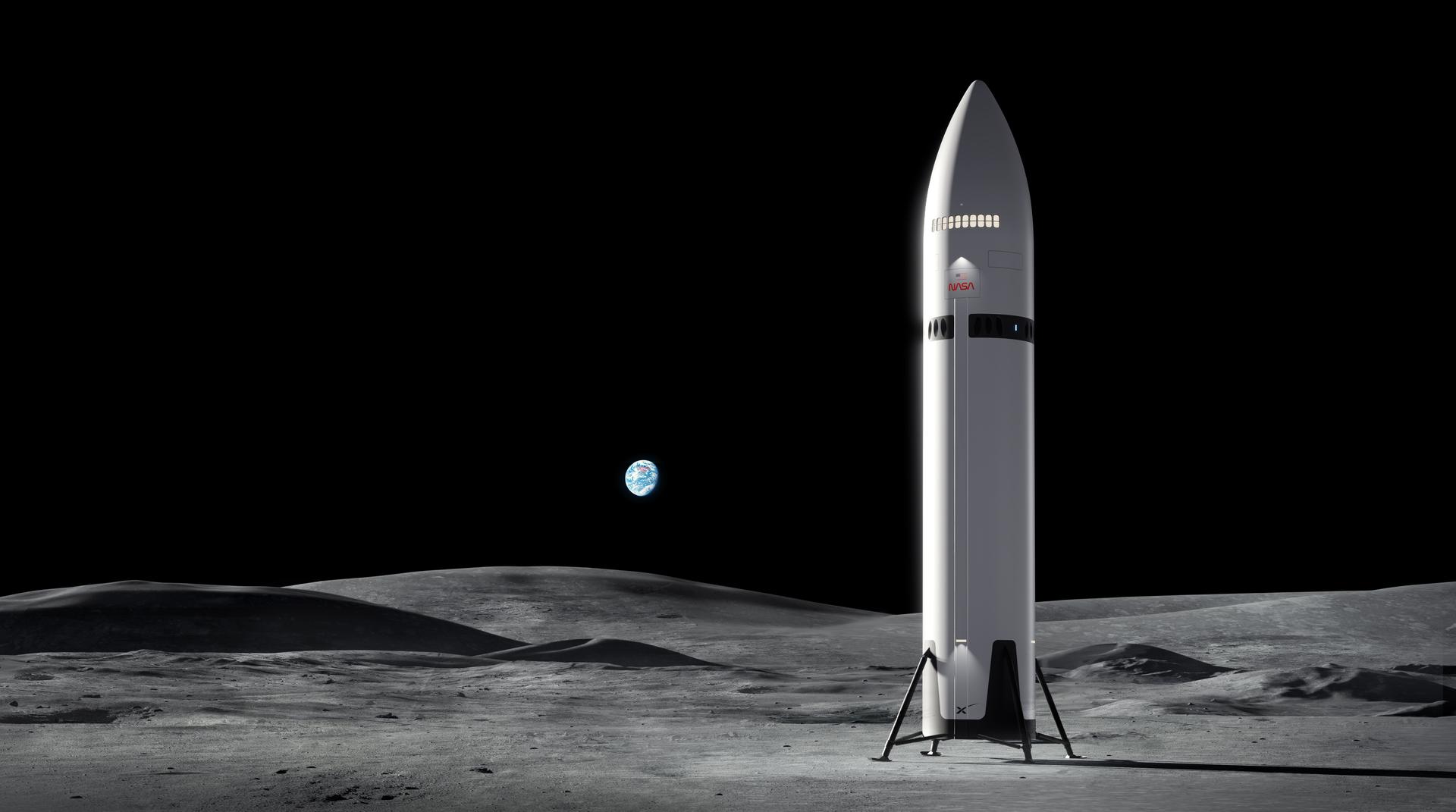
Starship’s first orbital cargo flight flew September 28. Follow the path to Moon cargo through HDR, Lerch Bates, Thompson, Axiom Space, Lockheed Martin, Toyota and JAXA.
Read the storyThis page did not load.
Start with a flight, a company, or the map. The record is the same in every room.
Upcoming flights. Open one for who flies it, what is on board, and the public money.
CompaniesCompanies on the next flights. Open a name for the jobs and the hardware.
NASA Moon BaseCargo I, II, III at the south pole. Crew in parallel on Artemis. A walk, not a list.
Open a flight for who flies it, what is on board, and the public money.
Open a company for the jobs, the hardware, and the flights they sit on.
Inside the stack · 03
Starship’s first orbital cargo flight flew September 28. Follow the path to Moon cargo through HDR, Lerch Bates, Thompson, Axiom Space, Lockheed Martin, Toyota and JAXA.
Read the story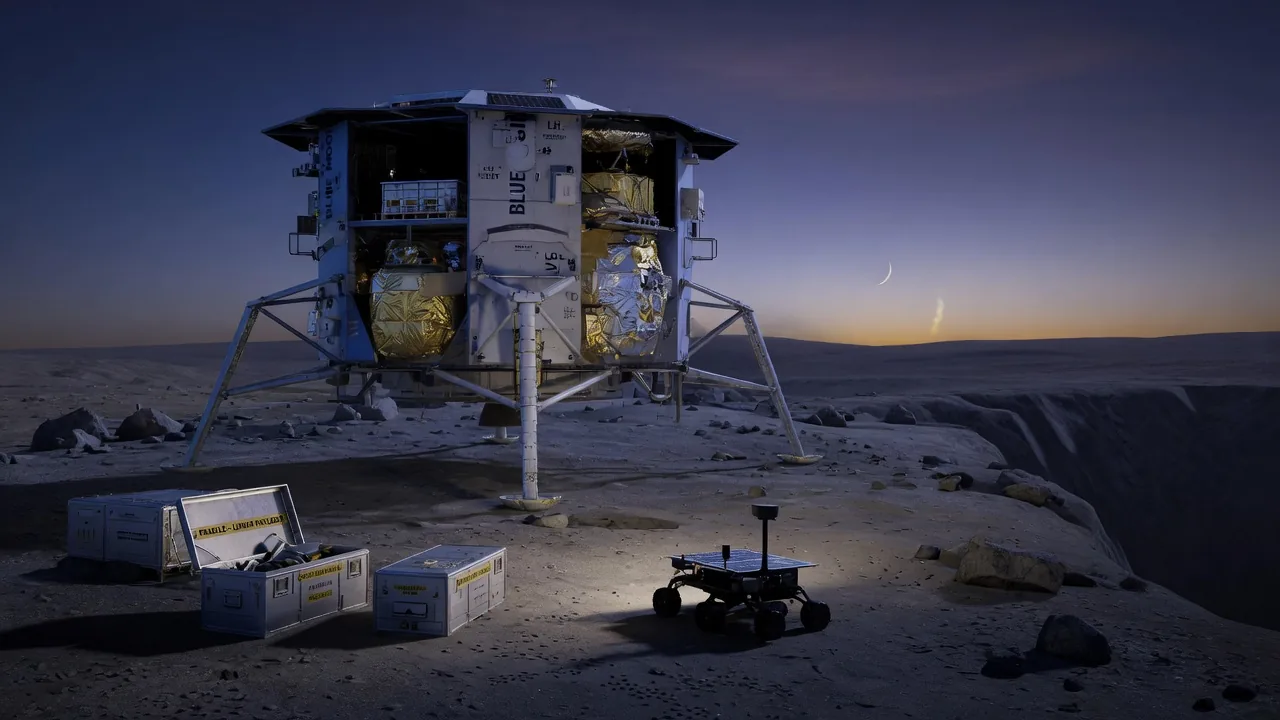
This is NASA's cargo-first Moon Base: landers put hardware on the land, then crew arrives. I, II, and III are NASA names, not fly order. Griffin-1 (II) is first on the clock.
 Landing map
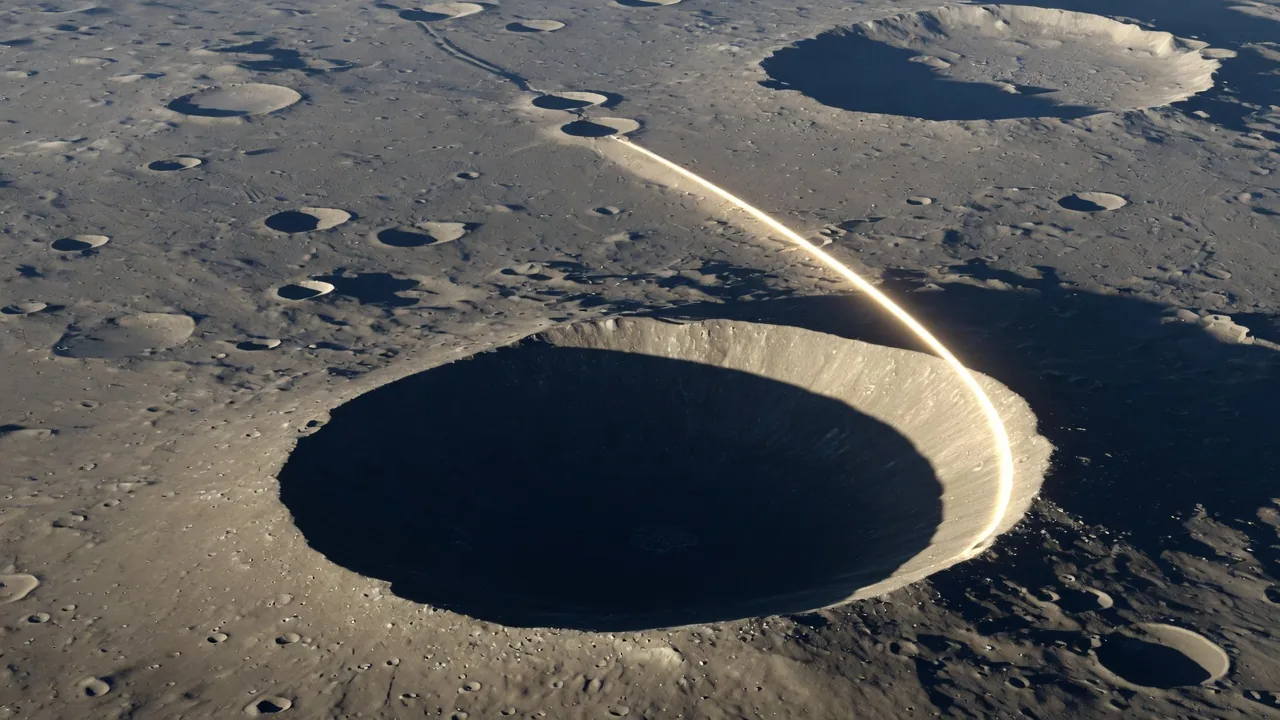
Every public flight on the site it headed for. A globe of records, not a game map.
Open the mapLetters, flight files, and packs. Same named facts as the site. The price is for the PDF, not a ride.
Lunar site selection · modern era
Each flight sits on the site it headed for: landed, tipped, hard landing, or planned. Crew and orbit flights stay off the plate. One photograph of the near side, and a plotted chart of the south pole. Click a flight to open its Moon Imports record.
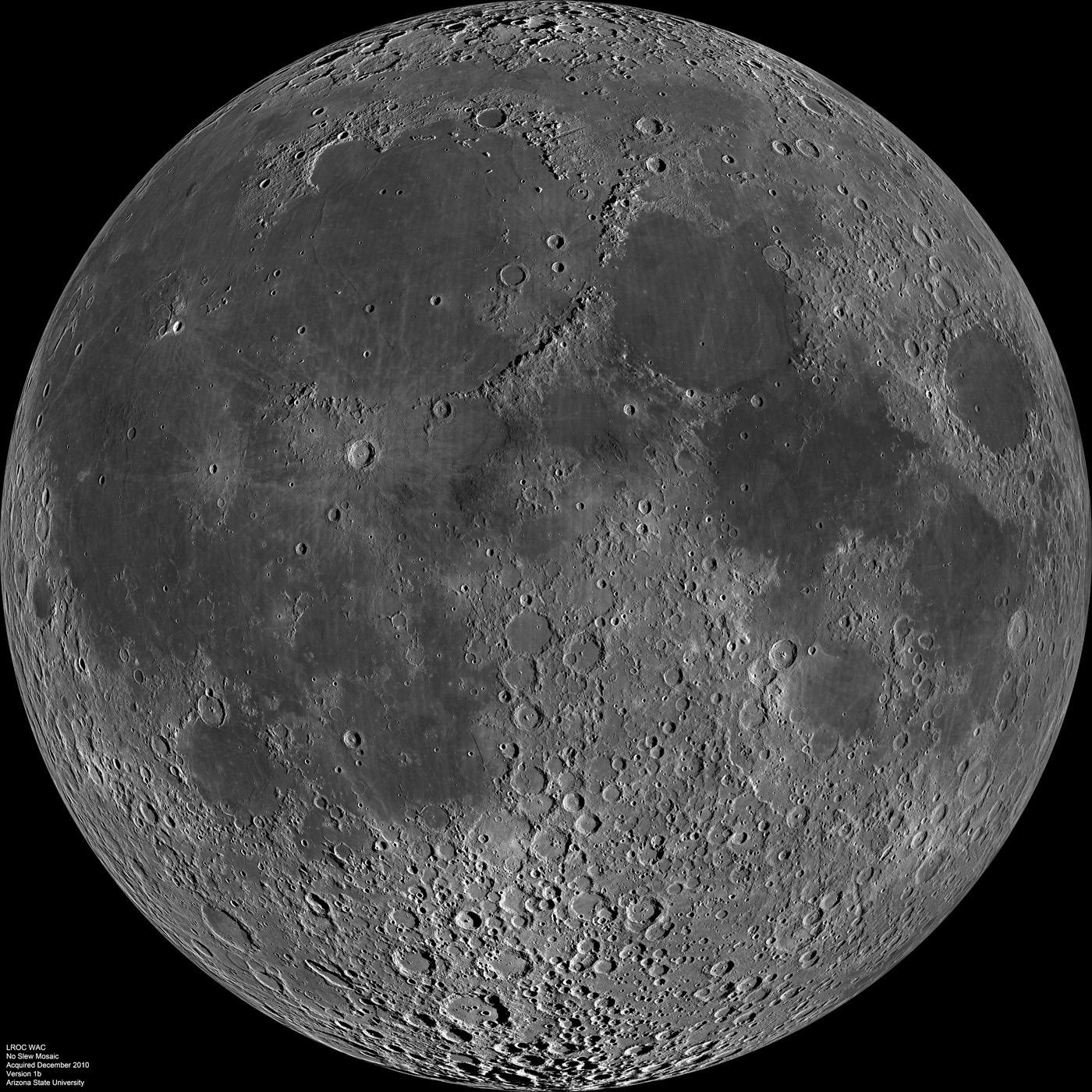
Photograph: NASA / GSFC / Arizona State University, LROC WAC nearside mosaic, public domain. The near-side plate is that photograph, clipped to the disk, under an orthographic graticule. The south pole plate is drawn, not photographed. Sites are the planned or intended target. Hard landings and flights that never arrived stay at the site they aimed for.
Program hub
A lasting presence at the south pole. NASA’s I, II, and III are names, not the order they fly. Cargo first. Crew in parallel.
| Mission | Who | Program | Rocket | When | Status | Cargo | Public $ |
|---|
Need a work PDF?
Pay on this page
Card stays with Stripe. You do not leave Moon Imports.
Change plan
One plan. Pick what you want next, then confirm the amount.
Inside the stack / 09
NASA's Moon Base Phase 2, early habitation, puts roughly 60 tons on the south pole across 24 landings and about 27 launches from 2029 through 2032. The manifest runs from power and comm stations to seven rovers, including JAXA and Toyota's pressurized rover, assigned to SpaceX Starship cargo. On Earth, NASA is evaluating bulk launcher buys for Moon Base.
Open this week ↓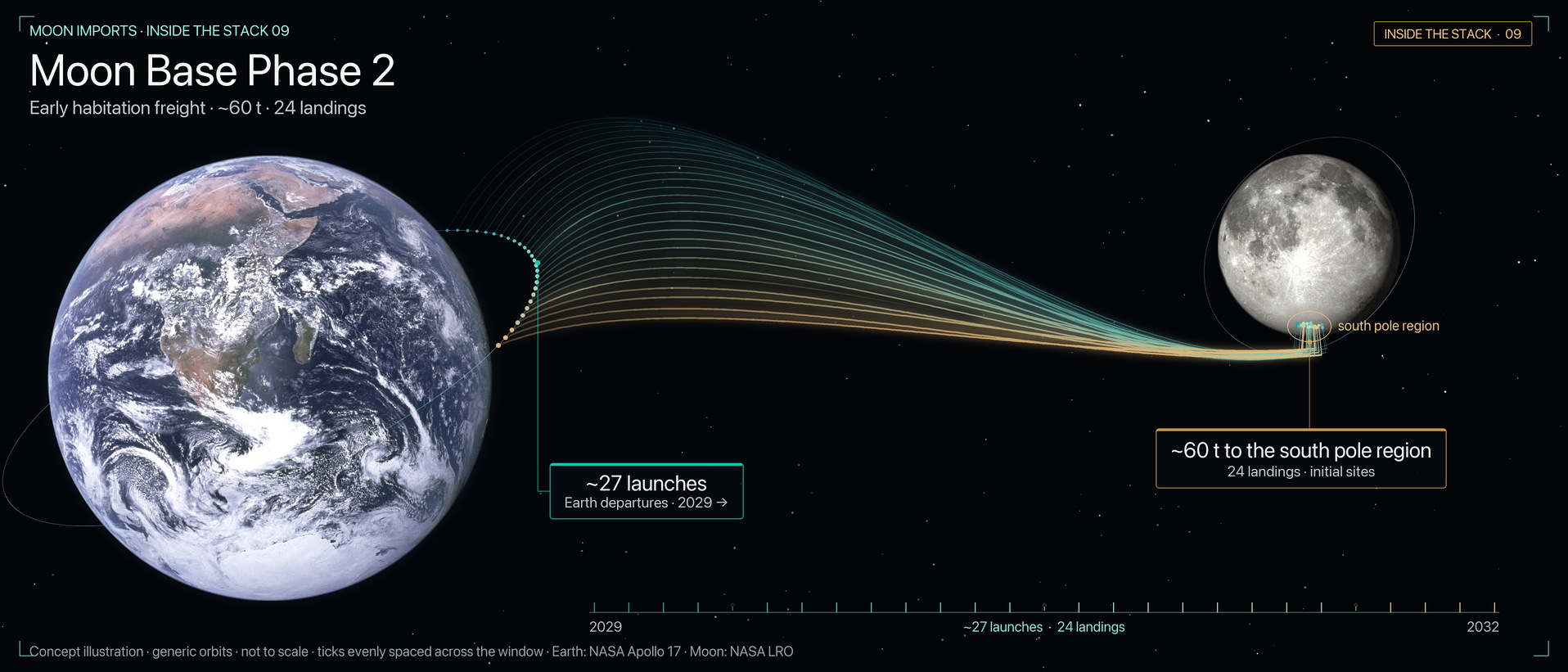
This week / 6 October 2026
Moon Base program manager Carlos García-Galán told Bloomberg on 6 October 2026 that NASA is evaluating bulk buys of launchers for Moon Base, with the first set expected in the near future.
NASA's Phase 2 plan calls for about 27 launches and 24 landings. The Launch Services Program is named to buy dozens of commercial launches a year for Moon Base. NASA's Moon Base deck has Launch Services task orders starting in calendar 2027.
Sources: Bloomberg, 6 Oct 2026 · NASA plan
Bulk launch buys for Moon Base, under evaluation at NASA now.
Earth build ↓Power stations, comm stations, seven rovers, and early habitats on NASA's Phase 2 list.
Phase cadence ↓Named seats already on the record: Firefly, Astrobotic, Intuitive Machines, and Blue Origin on Phase 1 landers; Astrolab and Lunar Outpost on the 2028 rover deliveries; JAXA, Toyota, and SpaceX on the pressurized rover.
01 / Cadence
Phase 1 · Experiment runs from now through 2029: about 25 launches, 21 landings, and roughly 4 tons to the surface. Robotic missions gain reliable access and scout the south pole for Moon Base sites with CLPS landers, Lunar Terrain Vehicles, MoonFall drones, and early power, navigation, and communications demos. Moon Base II, Griffin-1, built by Astrobotic, now Voyager Lunar Systems within Voyager Technologies, launches in late 2026. NASA targets Artemis IV, the first Artemis crewed landing, for 2028, with two astronauts spending about a week near the south pole.
Phase 2 · Early Habitation runs from 2029 through 2032, and NASA sets its goal as the initial Moon Base operating capability: semi-permanent infrastructure, early habitation and logistics, and a crewed mission every six months. About 27 launches deliver roughly 60 tons across 24 landings on low, medium, and heavy cargo landers, with CLPS growing to the 5 ton class and a SpaceX Starship cargo lander assigned to JAXA's pressurized rover. The manifest: solar power stations, nuclear power demos, surface to orbit comm stations, seven rovers (LTV Gen 2, site prep, logistics, and excavator rovers, plus the pressurized rover), advanced MoonFall drones, and early habitation.
Phase 3 · Sustained Presence starts in 2032, when NASA begins assembling a permanent outpost where astronauts live and work for extended periods. The Users Guide counts about 29 launches, 28 landings, and roughly 150 tons for the phase, with CLPS growing to the 8 ton class. The plan calls for up to 38 tons of cargo a year on reusable heavy lift, delivering semi-permanent habitat modules, an operational fission surface power station, and pressurized rovers.
Sources: NASA overview · NASA plan · March deck · NASA lander update, 4 Aug 2026. The overview and the plan date Phase 2 from 2029 through 2032. The March deck slide dates the same Phase 2 totals 2029 through 2033, and the Phase 3 totals 2033 through 2036.
On Moon Imports: Phase 2 cargo · Moon Base hub
02 / Capacity
Phase 2 calls for low, medium, and heavy cargo class landers. NASA's mass marker: Commercial Lunar Payload Services (CLPS) grows toward 5 ton class deliveries in Phase 2 (then about 8 tons in Phase 3), and large cargo draws on the Human Landing System / Human-class Delivery Lander path.
About 60 tons across 24 landings works out to roughly 2.5 tons a landing on average. For scale, Moon Base II carries more than 1,100 pounds of cargo on Griffin-1, including Astrolab's FLIP rover, and NASA sizes the SpaceX and Blue Origin cargo landers for about 12 to 15 tons of payload each.
On Moon Imports: Griffin-1 · Starship lunar cargo
03 / Power
NASA's Phase 2 plan calls out improved solar stations at 10 kW+ in sunlight and about 360 kWh through shadow, plus radioisotope thermoelectric generator (RTG) class stations and a reactor surface power demo. Phase 2 assets begin routinely using radioisotope heater units (RHUs) and RTGs to survive the night. Operational fission stations arrive in Phase 3.
Northrop Grumman runs Lunar Infrastructure Demos (LID): three surface demos built on power and avionics hardware from Gateway's HALO module, testing night survival through shadow periods of several days and shared surface power. Zeno Power flies an Am-241 radioisotope heater on Blue Ghost Mission 5. In 2022, NASA and the Department of Energy picked three Fission Surface Power design teams for a 40 kilowatt class system: Lockheed Martin with BWXT and Creare, Westinghouse with Aerojet Rocketdyne, and IX, the Intuitive Machines and X-energy joint venture.
On Moon Imports: Northrop LID · Zeno night heater
04 / Comms
Phase 2 calls for surface to orbit stations and a local mesh on the order of 10 km, so assets can talk to each other across the surface. NASA's deck adds permanent surface cell towers, integrated network terminals that serve many users at once, and a lunar clock demo, building on Phase 1's initial five satellite relay constellation.
Nokia flew a Lunar Surface Communications System with 4G/LTE on IM-2. SSTL's Lunar Pathfinder rides Blue Ghost Mission 2 and Elytra and relays for a NASA user terminal on the lander. Intuitive Machines' Altus-1, the first satellite in its Near Space Network relay for NASA, flies with IM-3 Trinity carrying NASA's NavCube3-mini receiver. ESA Moonlight partners, including ispace, Leonardo, and Telespazio on the public MoU, study the European relay layer.
On Moon Imports: Nokia LSCS · Lunar Pathfinder · Altus-1
05 / Mobility
NASA JPL's four MoonFall drones arrive at the south pole in 2028 on Firefly's Elytra, and each makes multiple flights over one lunar day, about 14 Earth days. Each drone flies several propulsive hops covering up to 50 km in total. Advanced MoonFall drones follow in Phase 2.
Seven rovers sit in the Phase 2 list, including Lunar Terrain Vehicle (LTV) Gen 2 plus site prep, logistics, and excavator machines. Phase 1 LTVs have Earth builders: Astrolab's CLV-1, about 2,000 pounds and more than 6 mph on level terrain, and Lunar Outpost's Pegasus, more than 9 mph and operational for up to a year. Blue Origin delivers both in 2028 under CX-2. For Phase 2, NASA's deck plans a 2027 on-ramp request for proposals to widen the LTV vendor pool, then rover task order competitions every 18 to 24 months.
MoonFall traverse: JPL, 26 March 2026.
On Moon Imports: MoonFall drones · CLV-1 on CX-2 · Pegasus on CX-2
06 / Heavy
Japan's pressurized rover, the Lunar Cruiser built by JAXA with Toyota, is shirt sleeve for two crew, about 15 tons of rover and 3 tons of cargo capacity. NASA assigned a SpaceX Starship cargo lander to deliver it no earlier than fiscal 2032.
NASA's deck counts the pressurized rover inside Phase 2's roughly 60 tons, alongside CLPS deliveries growing toward the 5 ton class. Early pressurized habitat modules in Phase 2 stay demo class: minimal life support on external power, logistics in the 0.5 to 1.5 ton class, surface mating demos, and a small cargo return demo. Blue Origin's lunar surface habitat delivery, no earlier than fiscal 2033, falls in Phase 3.
On Moon Imports: Lunar Cruiser · JAXA rover cargo · Starship lunar cargo
07 / Earth build
NASA plans dozens of commercial launches a year through the Launch Services Program for Moon Base. Launch rides on the record: SpaceX Falcon Heavy for Griffin-1, Blue Origin's New Glenn for Blue Moon MK1 Endurance, SpaceX Falcon 9 for IM-3 Trinity, and SpaceX Starship cargo for JAXA's pressurized rover. Phase 1 landers on the record: Firefly's Blue Ghost, Astrobotic's Griffin (Griffin-1, Moon Base II), Intuitive Machines' Nova-C (Trinity, Moon Base III), and Blue Origin's Blue Moon MK1 (Endurance, Moon Base I). Astrolab, Lunar Outpost, JAXA, Toyota, and SpaceX hold named seats on the mobility and heavy cargo path.
NASA's plan lists these as Phase 2 elements: solar stations, RTG stations, the reactor surface demo, surface mesh stations, LTV Gen 2, excavators, early habitat modules, and advanced MoonFall drones.
On Moon Imports: Launch buys · Walk Phase 2
Forward look
Phase 2 puts roughly 60 tons on the south pole across 24 landings from 2029 through 2032, with a crewed mission every six months. The rides already named: JAXA and Toyota's pressurized rover on SpaceX Starship cargo, Astrolab's CLV-1 and Lunar Outpost's Pegasus on Blue Origin delivery in 2028, and NASA JPL's MoonFall drones on Firefly's Elytra.
Next on the record: the bulk launcher set, expected in the near future; Launch Services task orders from calendar 2027; and the LTV on-ramp in 2027.
Open the News kit · flight card for Starship lunar cargo